The Greek Debt Crisis: Democracy is on hold, and up for Ransom

I have been pottering about with some maths for you… slightly boring I know, but important given the total codswallop we have all been told over the last few years about the EU and its political and financial remits within member states.

Today the “troika” of the IMF, the European Central Bank, and the European Commission agreed to lean Greece 130bn euros, £110bn, or about $170bn.

Let me put that another way:

£110,000,000,000 

But what does this number actually mean? Greece has a population of about 11,300,000. Of these approximately half are of working age. Not all of those who are of working age actually do any work, and not all of those who work pay any taxes, but lets keep this simply for the time being. So about 5,650,000 people are trying to pay back this debt.

This all means that every single Greek of a working age has today been lent approximately £19,500

Given that the average annual salary in 2010 in Greece was equivalent to £17,400 this means that they have been lent about 14 months salary each. And this is on top of an even bigger loan last year, and it has already been indicated that there will need to be a third bail out some time before the end of the decade.

And there are serious political impactions to all of this too. As a consequence and requisite for the loan,

  • Greece will undertake to reduce its debt from 160% of GDP to 120.5% by 2020
  • Private holders of Greek debt will take losses of 53.5% on the value of their bonds, with the real loss as much as 70%
  • Greece’s economic management will be subjected to permanent monitoring by eurozone experts on the ground
  • Greece will amend its constitution to give priority to debt repayments over the funding of government services

Notice that last one… yep… AMEND ITS CONSTITUTION!

Staggeringly Greece has also agreed to put off elections till it can afford to hold them. Yep… Democracy is on hold, and up for ransom, till Greece pays its political and economic masters.

Hmm… whats the price of democracy again?

Well now you know. £19,500

5 Comments

Filed under Timology

Indian (a) Jones and the Temple of Treasure…

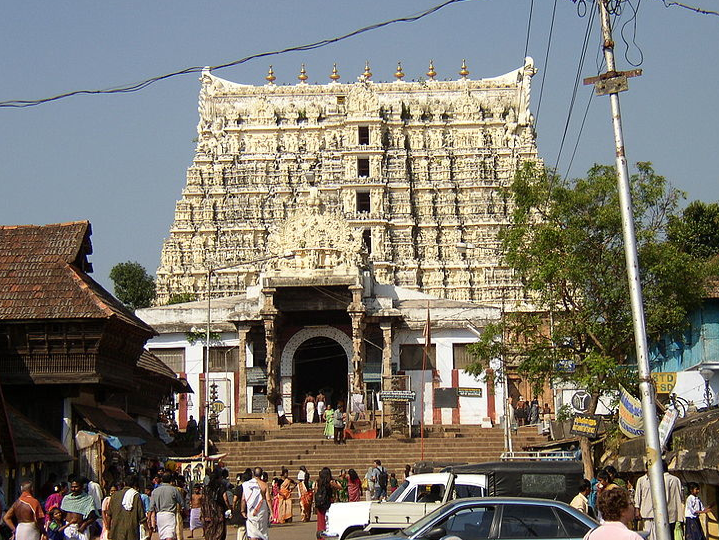
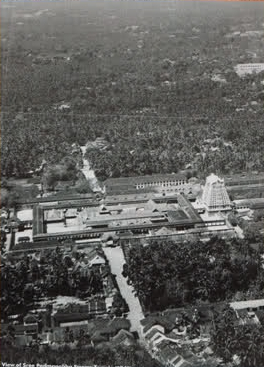
Officials in India have begun the lengthy process of creating a digital inventory of priceless treasures unearthed from vaults in the Sree Padmanabhaswamy temple in Kerala.

Five vaults at the temple in Kerala were opened last year amidst a frenzy of speculation and excitement… as their contents were rumoured  to contain a king’s ransom. In a tale that could have been lifted straight from Indiana Jones (please forgive the pun in the heading…) local legend has long held that vast riches were interred in the walls and vaults of the temple by the Maharajas of Travancore over many years. The current incumbent is the splendidly titled Maharajah of Travancore, Uthradan Thirunaal Marthanda Varma. I bet any money (including all of his) that he has an amazing ‘tash…

A local court has today ordered the sixth vault to remain closed until the contents of the first five are digitised, and unsurprisingly, security is tight at the temple, as the contents of five vaults alone are now believed to be worth a staggering 900bn rupees, or about £12bn…. roughly the amount it will cost to host the London Olympics…

Neither the state of Kerala nor the descendants of the Travancore royal family, who are the custodians of the temple, have made any claim on the treasure, which they say is the property of the temple and its deity.

In July last year the BBC reported Indian media was awash with wildly speculative reports about the treasures buried in the temple’s six underground vaults. They talk about “very old gold chains, diamonds and precious stones which cannot be valued in terms of money”.

One report talks of 450 golden pots, 2,000 rubies and jewel-studded crowns, 400 gold chairs and the statue of a deity studded with 1,000 diamonds. Apparently, all this amounted to 65 “treasure sacks” which was then estimated to be worth some $20bn – more than India’s annual education budget. There were stories of curses, charms, and snakes that protect the loot… obviously.

Soutik Biswas described how; “A bit of drama accompanied the opening of the vault then. The rusting locks were broken after a two-and-a-half hour effort and an ambulance waited outside to attend to any “emergency”. Floodlights and torches lit up the place, and fans pumped air into the vaults. Officials found “four chests made of brass which contained old coins”; a “granary-like thing” full of gold and silver coins; gold pots; and a six-chamber wooden chest full of diamonds, rubies, emeralds and other precious stones. They also found more than 300 gold pots.”

Perhaps to add an air of mystery and intrigue, non Hindus are not allowed to enter the temple complex, and the Indiana Jones theory also goes back in time; as early as 1933, Emily Gilchrist Hatch wrote a travel guide for Travancore, recording that the “temple had a vast amount of wealth lain in vaults”. She wrote that 25 years earlier, temple authorities would open the vaults and use the wealth “when the state required additional money”. She also added = that a group of people tried to enter the vaults once, found it “infested with cobras” and fled. Why did it have to be snakes?

2 Comments

Filed under Timology

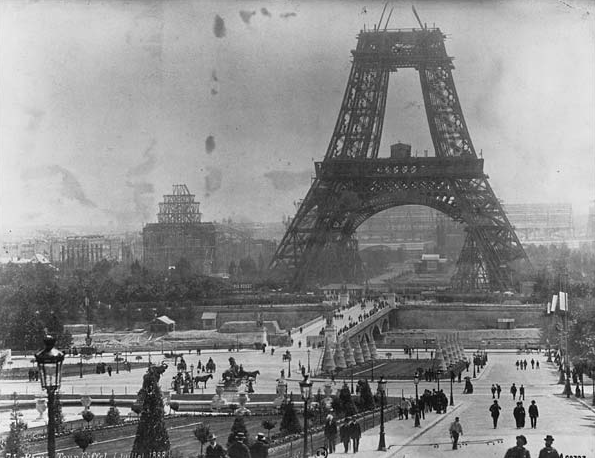
Eiffel Tower under construction

Salut mes petit pois, this one has been doing the rounds on Twitter and t’internet, but thought it was worth sharing here with you…

A few petit facts interesant pour vous: The pig iron structure of the Eiffel Tower weighs 7,300 tonnes… as the tower was initial supposed to be demolished in 1909, and as a demonstration of the economy of design, if the 7,300 tonnes of the metal structure were melted down it would fill the 125-metre-square base to a depth of only 6 cm. And secondly, depending on the ambient temperature, the top of the tower may shift away from the sun by up to 18 cm because of thermal expansion of the metal on the side facing the sun.

And for all those of you who thought you were going to get a glimpse of the actual construction… Bien, et Mange tout alores!

Leave a comment

Filed under Technology, Timology

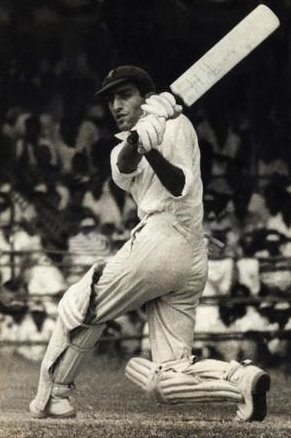
Tiger Pataudi, the Ninth Nawab of Pataudi.

Last year Oxford (how wonderfully Spire-Centric that will sound by the time you get to the end of this sentence…) lost a sporting legend following the death of The Nawab of Pataudi, former cricket Blue, and Captain of India.

Nicknamed Tiger Pataudi, Mansoor Ali Khan was the ninth Nawab of Pataudi until 1971, when India abolished royal entitlements through the 26th Amendment. He played over 300 First Class games, and 46 tests, top scoring 203 not, played 137 first class matches for Sussex County Cricket Club scoring 3,054 runs at an average of 22.29, and captained Sussex in 1966. In India, he played first-class cricket for Delhi in the North Zone until 1966, and then for Hyderabad in the South Zone. He was Wisden Cricketer of the year in 1968.

His life was always a privileged one… if only one tinged with sadness; His father died while playing polo in Delhi on Mansoor’s eleventh birthday in 1952, whereupon Mansoor succeeded as the ninth Nawab. He was classically educated at A.M.U Minto Circle School in Aligarh, Lockers Park Prep School in Hertfordshire, Winchester College, and finally read Arabic and French at Balliol College. Obviously.

He was a remarkable cricketer, as he literally saw double… he was a passenger in a car which was involved in an accident, and a shard of glass from the broken windscreen penetrated and permanently damaged his right eye. The damage caused Pataudi to see a doubled image. It was feared this would end his cricketing career, but Pataudi was soon in the nets learning to play with one eye!

His memorial lecture in Calcutta was given by the no lesser august cricketing demigod, Imran Khan. He tells the Tiger’s tale of overcoming great odds to captain a great cricketing nation, and about the power of sport and education, as well as his time in Oxford. Its an interesting watch.

Leave a comment

Filed under Oxford: The Perspiring Dream, Timology

Thupten Jinpa, the Dalai Lama’s English Translator

This is an in-depth interview where Krista Tippett discusses life in a monastery, philosophy, linguistics, and strange experiences with the chief English translator for the Dalai Lama.

Geshe Thupten Jinpa, a Buddhist scholar and former monk, shares the intricacies of Tibetan Buddhism that can’t be conveyed in public teachings, and what happens when this ancient tradition meets modern science and modern lives. His very personable and personal thoughts are insightful, interesting, and wonderfully modest… It’s a long interview, and you have to ignore the technological fiddling at the start, but well worth listening to.

Leave a comment

Filed under Tibetology, Timology

Ugly Oxford and curious corners.

As you can probably see from the photos below I have been amusing myself recently by wondering around Oxford learning new things about this old city. It’s still a beautiful city, and is especially picturesque at this time of year when the thin sun lights the stones, but offers little warmth.

I have especially been trying to make friends with the less well loved bits of Oxford; anyone should be moved by Christ Church, Port Meadow is photogenic beyond words, and the Rad Cam is a dazzling architectural tribute to learning, but what about the rest? Can anyone truly and honestly say that they appreciate Cornmaket Street? Marvel at the authority that exudes from County Hall? Are spurred to attain higher knowledge by the Westgate Library? No, I thought not. And its not like I am alone on this one… read what Bill Bryson in his Notes From a Small Island has to say about Oxford:

“You know, we’ve been putting up handsome buildings since 1264; let’s have an ugly one for a change.’ Then the planning authorities had to say, “Well, why not? Plenty worse in Basildon.”” ‘Then,’ Bryson continues, ‘the whole of the city -students, dons, shopkeepers, office workers, members of the Oxford Preservation Trust – had to acquiesce and not kick up a fuss. Multiply this by, say, 200 or 300 and 400 and you have modern Oxford. And you tell me that it is one of the most beautiful, well-preserved cities in the world? I’m afraid not. It is a beautiful city that has been treated with gross indifference and lamentable incompetence for far too long, and every living person in Oxford should feel a little bit ashamed.’ I can’t agree more.

While Bryson reserves his ire for the ‘criminally insane’ “bypass right across Christ Church Meadow,” I too have especial hatred for two bits of my beloved city: Carfax and The Plain Roundabout. Possibly the two most major meeting hubs of the city, opportunities to showcase our architectural prowess and history, but drab, boring, expressionless windswept junctions where bus-stops jostle for attention with knackered bike racks while everyone dashes past with eyes averted. I therefore decided to try and dig up some information that might induce me to love the unlovable, and care for the ugly. (After all, my mother managed to…) (had to get there before you lot did…)

The sad news is that I totally failed in both counts… both had architectural curiosities and interesting features, but the emphasis here has to be on the ‘had.’

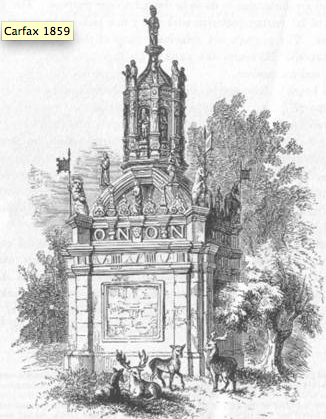
Carfax derives its name from the Latin ‘Quadrifurcus,’ or the French ‘Quatre faces.’ It is one of only two places in England where the two crossing road both change their names… giving the four ‘faces’ (and there is a prize if you can tell me the other one…) The Tower at the northwest corner of Carfax is all that remains of the 13th century St Martin’s Church. The tower is a rather unimpressive 23 meters tall, and this was set as the maximum hight of any subsequent build in central Oxford, resulting in a rather low rise cityscape. Unimaginative at best, especially when it is not even the oldest building in Oxford by a country mile …  It was the official City Church where the Mayor and Corporation were expected to worship, between about 1122 and 1896, when the main part of the church was demolished to, wait for it… make room for traffic. Great; so we collapsed the primary church in the city, in the prime location, to make way for a taxi rank and bus stop.
But wait… there’s more… in 1610 the city erected a conduit at Carfax to feed water to the vicinity. A nice, stone, noble sort of thing… practical too, especially if you like to drink clean water, which most people do. However by 1789 the city planners had obviously already decided upon the devastation of Carfax and promptly gave it to Lord Harcourt, who set it up in Nuneham Park, allowing the original site to be widened for, yes,  coach traffic.

To cap it all, Carfax’s only two features of note are an original Gilbert Scott K2 phone box and a small ‘peace stone.’ Even these are rather pathetic; the K2 was not originally located there and was moved in to please tourists, and the peace stone proclaims the short-lived peace when Napoleon was imprisoned on Elba in June 1814. Waterloo was still to come.
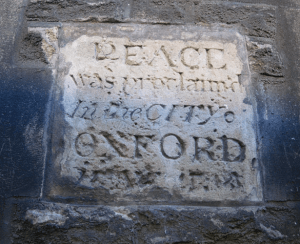
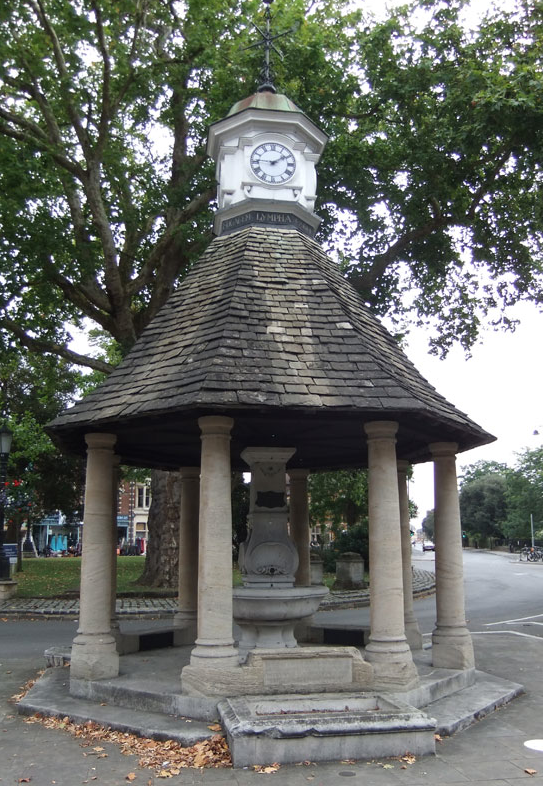
So what of the noble Plain Roundabout? That has a nice water fountain sort of thing… surely that has some merit?

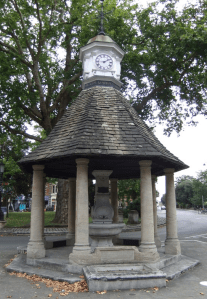
The octagonal building, designed by P.E. Warren in 1899, is supported on eight Tuscan columns, has a central fountain with a scallop motif and four cocks, and a conical tiled roof with clock and weather vane… all very quaint, but a little out of place in the middle of a busy roundabout.

The structure was rather typically opened two years late, some time after Queen Victoria’s Diamond Jubilee, on the site of the old toll-house. The fountain no longer works, and the troughs for the horses are filled with flowers in summer… if they are not ripped up by students marauding home after a night on the tiles down the Cowley Road.
The only other possible source of interest for the site is also now missing… a war memorial dedicated to the 142 men of the First Battalion Oxfordshire Light Infantry who died in the South African (Boer) War of 1899 to 1902. It was shipped off to Dalton Barracks near Abingdon in the 50’s to make way for… you guessed it… more traffic.

The actual statue is rather nice… see below. It was unveiled by the Bishop of Oxford on 19 September 1903 in the former churchyard of St Clement’s Church (now the site of the Plain roundabout.) It’s an interesting aside that the 1st Battalion of the OBLI were under orders for India, and the ceremony took place while it was still unfinished so that they could be present: There was no statue on top of the plinth at the time of its ‘unveiling.’

Between 4,000 and 5,000 people attended the ceremony. The procession, headed by the Mayor’s Sergeant carrying the City’s Mace, started at Magdalen College School in Cowley Place.

General Green Wilkinson said with a certain amount of posthumous irony that the memorial was “a sacred possession, and would be handed down for many years in the City of Oxford amongst the beauiful buildings and historical houses.” The Mayor said that they had tried to find a site even more public than the Plain, but it would nevertheless “be always prominent before the citizens.”

How sad that it is now in a site nowhere near prominent to the hearts and minds of the good citizens of Oxford; on a barracks in Abingdon.

Bryson acknowledges Oxford’s many virtues: in his view ‘it has moments of unutterable beauty’ and ‘a scattering of prospects that melt the heart’ and he speaks too of ‘being immersed in an architectural treasure house, one of the densest assemblages of historic buildings in the world’, but he also warns that in the light of the city’s planners’ appalling lapses over the years there is little room for complacency. I could not agree more, and believe me, if I could call the Luftwaffe back to have a go rearranging Carfax and the Plain, I might just consider it…

11 Comments

Filed under Oxford: The Perspiring Dream, Photography, Timology

Another evening of hard labour draws to a close…

Leave a comment

Filed under Oxford: The Perspiring Dream, Photography, Timology

With her fair and floral air, and the love that lingers there…

Leave a comment

Filed under Oxford: The Perspiring Dream, Photography, Timology

The Sikh of Tweak Sheikhs Pakistan

You probably know that I am a bit of a cricket fan. You probably also know that my jokes are legendarily poor. TMS Live text commentary therefore appeals to my particular taste of distraction (see posts passim…) Today, during day three of the second England Pakistan Test from the Sheikh Zayed stadium in Abu Dhabi, the England spinner Monty Panasar found prodigious turn in the pitch to cut swathes into the Pakistan top order.

The England fans love Monty; his relentless enthusiasm for the game, and wild celebrations of wickets are famous, as is his total inability to field and bat (with the exception of in Cardiff, but dont remind our friends from down under.) Despite his heroics in that Ashes test he was dropped in 2009 and has rather lived under the shadow of England’s first choice of spinner, Graeme Swann. The dusty and turing wickets of this winter’s desert tour have however demanded his recall, and the selectors have been rewarded for their choice.

Towards the end of the day the commentator asked for contributions or suggestions for tabloid style newspaper headlines of the day’s events. I tweeted my suggestion in, and low and behold it was aired on the BBC. This was the second time my comments have been put out there by the BBC… I wonder if they would like to commission or sponsor this blog… no? thought not.

1 Comment

Filed under Timology

A Boat full of Muppets, and an Attic full of Puppets

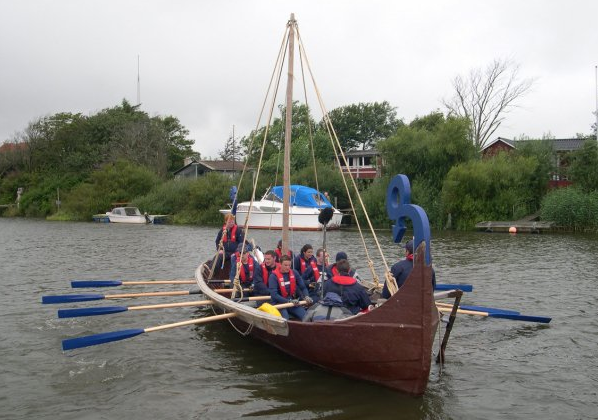
A few years ago I made a silly bet with a friend of mine who is a TV director. Nothing unusual in that. However, the bet was that I could not compete in a rowing race across the North Sea in Viking longboats. It was basically an Oxford vs The Other Place race for 500 miles from Ribe in Denmark to Harwich in England vie Heligoland and all sorts of odd places. Needless, and with a hint of smugness and pride, I somehow managed to keep up, and we thrashed the Tabs by about 10 hours. The programme went out on Channel 4 in about 2007 and attracted 4 million viewers, who I am sure were pleased to see me slogging my guts out.

Anyhow, this same directing chum has a new cunning plan… a documentary about marionettes and memory, melancholy, and mirth. It is the story of a 93 year old magical puppet master who played to the crowned heads of Europe. Here’s the spiel:

Frank Mumford is 93 and a “half” years old he’s lived in a tiny flat in London’s Notting Hill Gate since 1946 surrounded by the memorabilia of a life well lived.  Frank’s not your ordinary garden variety 93 year old. He’s special, not only because of his strong independent lifestyle, living alone as he approaches 100, but also because Frank and his late wife, Maisie, created one of the most glamorous Marionette variety acts to ever grace the stage.

In the late 1940’s and 1950’s they played prestige venues all over Europe, including the Moulin Rouge, Paris,   London’s Savoy Hotel, and the Sporting Club, Monte Carlo. He performed for the Duke and Duchess of Windsor, Prince Rainer of Monaco, was given a gold cigarette case by General Franco, dined with Jean Cocteau and joked with Josephine Baker.  This remarkable documentary tells Frank’s story. The past, present and future, it’s a tale of princes and puppets, bitter rivalries and betrayal, of joy and tragedy.

And here’s the rub: They need lots of cash to pay off those pesky French authorities, and facilitate this brilliant project. Their fund raising page tells me that they are nearly half way towards their target, so please do chip in what you can; its a deliciously odd project that would not get made without our help!

Leave a comment

Filed under Oxford: The Perspiring Dream, Timology