Category Archives: Oxford: The Perspiring Dream

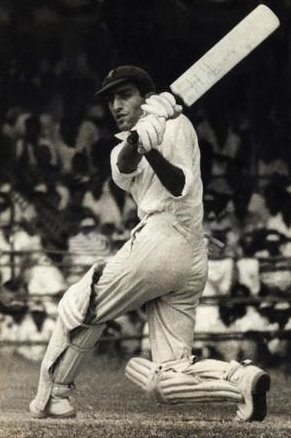
Tiger Pataudi, the Ninth Nawab of Pataudi.

Last year Oxford (how wonderfully Spire-Centric that will sound by the time you get to the end of this sentence…) lost a sporting legend following the death of The Nawab of Pataudi, former cricket Blue, and Captain of India.

Nicknamed Tiger Pataudi, Mansoor Ali Khan was the ninth Nawab of Pataudi until 1971, when India abolished royal entitlements through the 26th Amendment. He played over 300 First Class games, and 46 tests, top scoring 203 not, played 137 first class matches for Sussex County Cricket Club scoring 3,054 runs at an average of 22.29, and captained Sussex in 1966. In India, he played first-class cricket for Delhi in the North Zone until 1966, and then for Hyderabad in the South Zone. He was Wisden Cricketer of the year in 1968.

His life was always a privileged one… if only one tinged with sadness; His father died while playing polo in Delhi on Mansoor’s eleventh birthday in 1952, whereupon Mansoor succeeded as the ninth Nawab. He was classically educated at A.M.U Minto Circle School in Aligarh, Lockers Park Prep School in Hertfordshire, Winchester College, and finally read Arabic and French at Balliol College. Obviously.

He was a remarkable cricketer, as he literally saw double… he was a passenger in a car which was involved in an accident, and a shard of glass from the broken windscreen penetrated and permanently damaged his right eye. The damage caused Pataudi to see a doubled image. It was feared this would end his cricketing career, but Pataudi was soon in the nets learning to play with one eye!

His memorial lecture in Calcutta was given by the no lesser august cricketing demigod, Imran Khan. He tells the Tiger’s tale of overcoming great odds to captain a great cricketing nation, and about the power of sport and education, as well as his time in Oxford. Its an interesting watch.

Leave a comment

Filed under Oxford: The Perspiring Dream, Timology

Ugly Oxford and curious corners.

As you can probably see from the photos below I have been amusing myself recently by wondering around Oxford learning new things about this old city. It’s still a beautiful city, and is especially picturesque at this time of year when the thin sun lights the stones, but offers little warmth.

I have especially been trying to make friends with the less well loved bits of Oxford; anyone should be moved by Christ Church, Port Meadow is photogenic beyond words, and the Rad Cam is a dazzling architectural tribute to learning, but what about the rest? Can anyone truly and honestly say that they appreciate Cornmaket Street? Marvel at the authority that exudes from County Hall? Are spurred to attain higher knowledge by the Westgate Library? No, I thought not. And its not like I am alone on this one… read what Bill Bryson in his Notes From a Small Island has to say about Oxford:

“You know, we’ve been putting up handsome buildings since 1264; let’s have an ugly one for a change.’ Then the planning authorities had to say, “Well, why not? Plenty worse in Basildon.”” ‘Then,’ Bryson continues, ‘the whole of the city -students, dons, shopkeepers, office workers, members of the Oxford Preservation Trust – had to acquiesce and not kick up a fuss. Multiply this by, say, 200 or 300 and 400 and you have modern Oxford. And you tell me that it is one of the most beautiful, well-preserved cities in the world? I’m afraid not. It is a beautiful city that has been treated with gross indifference and lamentable incompetence for far too long, and every living person in Oxford should feel a little bit ashamed.’ I can’t agree more.

While Bryson reserves his ire for the ‘criminally insane’ “bypass right across Christ Church Meadow,” I too have especial hatred for two bits of my beloved city: Carfax and The Plain Roundabout. Possibly the two most major meeting hubs of the city, opportunities to showcase our architectural prowess and history, but drab, boring, expressionless windswept junctions where bus-stops jostle for attention with knackered bike racks while everyone dashes past with eyes averted. I therefore decided to try and dig up some information that might induce me to love the unlovable, and care for the ugly. (After all, my mother managed to…) (had to get there before you lot did…)

The sad news is that I totally failed in both counts… both had architectural curiosities and interesting features, but the emphasis here has to be on the ‘had.’

Carfax derives its name from the Latin ‘Quadrifurcus,’ or the French ‘Quatre faces.’ It is one of only two places in England where the two crossing road both change their names… giving the four ‘faces’ (and there is a prize if you can tell me the other one…) The Tower at the northwest corner of Carfax is all that remains of the 13th century St Martin’s Church. The tower is a rather unimpressive 23 meters tall, and this was set as the maximum hight of any subsequent build in central Oxford, resulting in a rather low rise cityscape. Unimaginative at best, especially when it is not even the oldest building in Oxford by a country mile …  It was the official City Church where the Mayor and Corporation were expected to worship, between about 1122 and 1896, when the main part of the church was demolished to, wait for it… make room for traffic. Great; so we collapsed the primary church in the city, in the prime location, to make way for a taxi rank and bus stop.
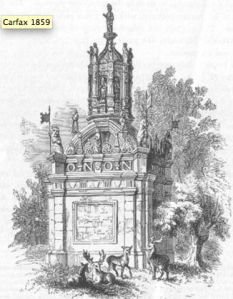
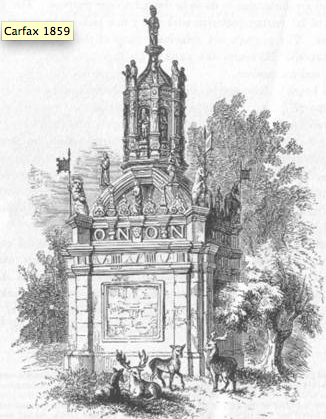
But wait… there’s more… in 1610 the city erected a conduit at Carfax to feed water to the vicinity. A nice, stone, noble sort of thing… practical too, especially if you like to drink clean water, which most people do. However by 1789 the city planners had obviously already decided upon the devastation of Carfax and promptly gave it to Lord Harcourt, who set it up in Nuneham Park, allowing the original site to be widened for, yes,  coach traffic.

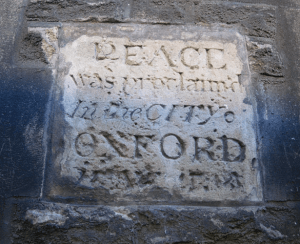
To cap it all, Carfax’s only two features of note are an original Gilbert Scott K2 phone box and a small ‘peace stone.’ Even these are rather pathetic; the K2 was not originally located there and was moved in to please tourists, and the peace stone proclaims the short-lived peace when Napoleon was imprisoned on Elba in June 1814. Waterloo was still to come.
So what of the noble Plain Roundabout? That has a nice water fountain sort of thing… surely that has some merit?

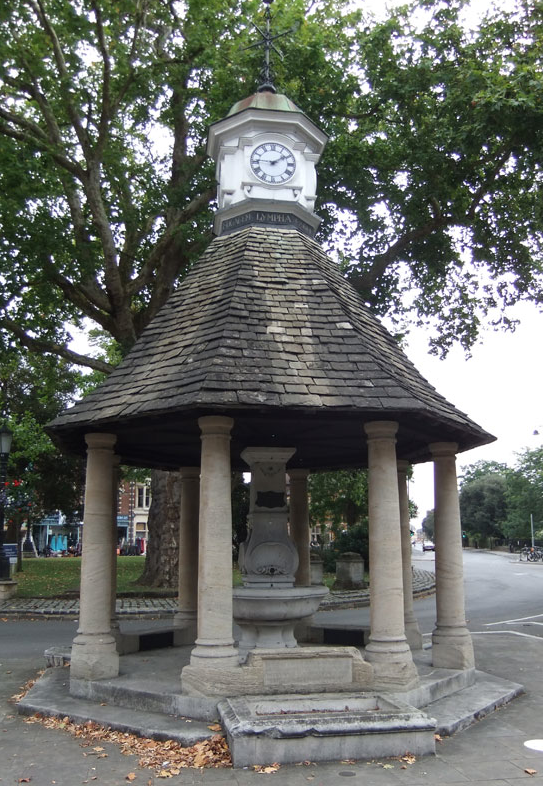
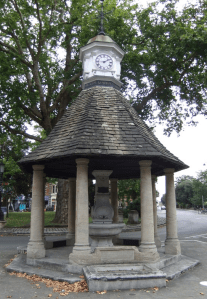
The octagonal building, designed by P.E. Warren in 1899, is supported on eight Tuscan columns, has a central fountain with a scallop motif and four cocks, and a conical tiled roof with clock and weather vane… all very quaint, but a little out of place in the middle of a busy roundabout.

The structure was rather typically opened two years late, some time after Queen Victoria’s Diamond Jubilee, on the site of the old toll-house. The fountain no longer works, and the troughs for the horses are filled with flowers in summer… if they are not ripped up by students marauding home after a night on the tiles down the Cowley Road.
The only other possible source of interest for the site is also now missing… a war memorial dedicated to the 142 men of the First Battalion Oxfordshire Light Infantry who died in the South African (Boer) War of 1899 to 1902. It was shipped off to Dalton Barracks near Abingdon in the 50’s to make way for… you guessed it… more traffic.

The actual statue is rather nice… see below. It was unveiled by the Bishop of Oxford on 19 September 1903 in the former churchyard of St Clement’s Church (now the site of the Plain roundabout.) It’s an interesting aside that the 1st Battalion of the OBLI were under orders for India, and the ceremony took place while it was still unfinished so that they could be present: There was no statue on top of the plinth at the time of its ‘unveiling.’

Between 4,000 and 5,000 people attended the ceremony. The procession, headed by the Mayor’s Sergeant carrying the City’s Mace, started at Magdalen College School in Cowley Place.

General Green Wilkinson said with a certain amount of posthumous irony that the memorial was “a sacred possession, and would be handed down for many years in the City of Oxford amongst the beauiful buildings and historical houses.” The Mayor said that they had tried to find a site even more public than the Plain, but it would nevertheless “be always prominent before the citizens.”

How sad that it is now in a site nowhere near prominent to the hearts and minds of the good citizens of Oxford; on a barracks in Abingdon.

Bryson acknowledges Oxford’s many virtues: in his view ‘it has moments of unutterable beauty’ and ‘a scattering of prospects that melt the heart’ and he speaks too of ‘being immersed in an architectural treasure house, one of the densest assemblages of historic buildings in the world’, but he also warns that in the light of the city’s planners’ appalling lapses over the years there is little room for complacency. I could not agree more, and believe me, if I could call the Luftwaffe back to have a go rearranging Carfax and the Plain, I might just consider it…

11 Comments

Filed under Oxford: The Perspiring Dream, Photography, Timology

Another evening of hard labour draws to a close…

Leave a comment

Filed under Oxford: The Perspiring Dream, Photography, Timology

With her fair and floral air, and the love that lingers there…

Leave a comment

Filed under Oxford: The Perspiring Dream, Photography, Timology

A Boat full of Muppets, and an Attic full of Puppets

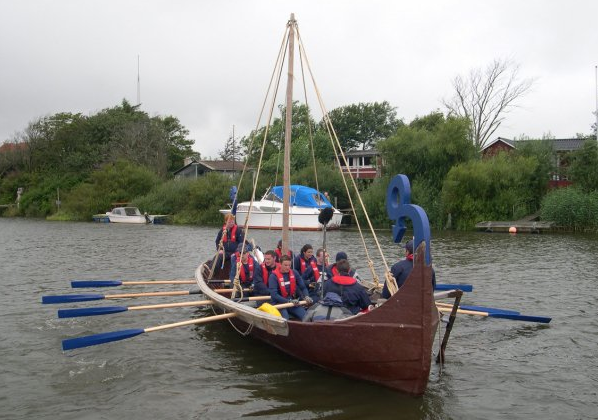
A few years ago I made a silly bet with a friend of mine who is a TV director. Nothing unusual in that. However, the bet was that I could not compete in a rowing race across the North Sea in Viking longboats. It was basically an Oxford vs The Other Place race for 500 miles from Ribe in Denmark to Harwich in England vie Heligoland and all sorts of odd places. Needless, and with a hint of smugness and pride, I somehow managed to keep up, and we thrashed the Tabs by about 10 hours. The programme went out on Channel 4 in about 2007 and attracted 4 million viewers, who I am sure were pleased to see me slogging my guts out.

Anyhow, this same directing chum has a new cunning plan… a documentary about marionettes and memory, melancholy, and mirth. It is the story of a 93 year old magical puppet master who played to the crowned heads of Europe. Here’s the spiel:

Frank Mumford is 93 and a “half” years old he’s lived in a tiny flat in London’s Notting Hill Gate since 1946 surrounded by the memorabilia of a life well lived.  Frank’s not your ordinary garden variety 93 year old. He’s special, not only because of his strong independent lifestyle, living alone as he approaches 100, but also because Frank and his late wife, Maisie, created one of the most glamorous Marionette variety acts to ever grace the stage.

In the late 1940’s and 1950’s they played prestige venues all over Europe, including the Moulin Rouge, Paris,   London’s Savoy Hotel, and the Sporting Club, Monte Carlo. He performed for the Duke and Duchess of Windsor, Prince Rainer of Monaco, was given a gold cigarette case by General Franco, dined with Jean Cocteau and joked with Josephine Baker.  This remarkable documentary tells Frank’s story. The past, present and future, it’s a tale of princes and puppets, bitter rivalries and betrayal, of joy and tragedy.

And here’s the rub: They need lots of cash to pay off those pesky French authorities, and facilitate this brilliant project. Their fund raising page tells me that they are nearly half way towards their target, so please do chip in what you can; its a deliciously odd project that would not get made without our help!

Leave a comment

Filed under Oxford: The Perspiring Dream, Timology

Grandma hid drugs between her legs

Some things you just can’t make up… Oh Oxford, I love you sometimes… and how on earth the Editor managed to steer his team from the inevitable headline gag I dont know.

This from today’s Oxford Mail.

A GRANDMOTHER was caught with her trousers down trying to conceal drugs between her legs.

Police raided Janice East’s house and found the 54-year-old in her bedroom trying to get rid of the evidence.

The grandmother-of-two, from Rose Hill had six wraps of heroin and five wraps of crack cocaine when officers swooped on October 5.

East was sentenced at Oxford Crown Court on Monday having earlier admitted two counts of possessing a Class A drug and breaching a suspended sentence.

Prosecutor Nikki Duncan said: “Police executed a warrant at her home address. They forced the door and went upstairs where they found her with her trousers pulled down. She was trying to conceal the drugs between her legs.”

The offence put East in breach of a four-month prison term, suspended for a year, which had been dished out by magistrates after almost identical drugs offences in May.

She has 31 previous convictions dating back to 1974.

Lucy Ffrench, defending, said East has been drug-free since November.

Judge Patrick Eccles jailed her for a total of 18 weeks.

Leave a comment

Filed under Oxford: The Perspiring Dream

Royal Asiatic Society. Lecture. 18 January. London.

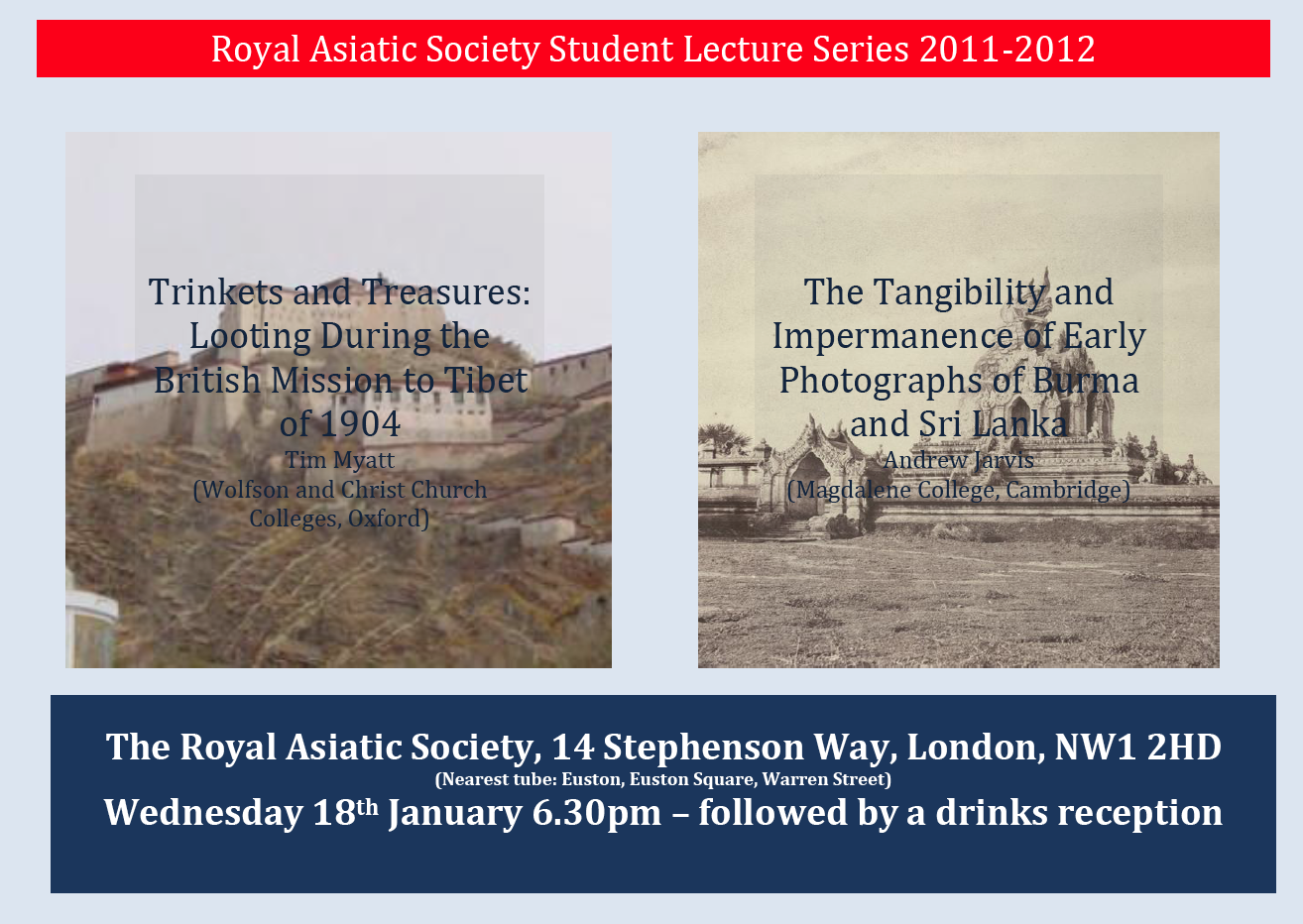
I doubt many of you will be at a loose end in London tomorrow evening, but if by chance your date has stood you up, or your heating has packed up, you might find warmth and distraction at the Royal Asiatic Society. I will be offering hot air on the subject of looting in Tibet. RAS Student Lecture Weds 18th January.
The next student series event at the RAS will take place next Wednesday evening 18th January and we have a very interesting double bill of lectures lined up. You can read all about it on their blog here.
Timothy Myatt will speak on ‘Trinkets and Treasures: Looting during the British Mission to Tibet of 1904’. Tim’s interest in Tibetan history and culture was stirred after spending eight months teaching in the Tibetan Monastery of Dip-Tse-Chok-Ling in Dharamsala, India, close to the Tibetan Government in Exile. He is now a doctoral student of Tibetan and Himalayan Studies at Wolfson College, Oxford and the General Secretary of the Internal Seminar of Young Tibetologists and has edited and published numerous books and papers on Tibetan culture, history and Anglo-Tibetan relations.
Apparently I have given the following comment:

I will present new research examining looting during the 1904 Younghusband Mission to Tibet. I will outline the social and cultural milieu that prevailed at the time and note the role models for, and influences on, those who took part in the mission. I will outline the position of L. Austine Waddell, the ‘archeologist’ to the Mission, and the controversial methods he used to acquire both personal and official collections. The aftermath of the Mission will be studied, focusing on contemporary newspaper reports from London and Delhi concerning the looting. I will then show how selected items looted from Tibet are now presented in British museums and collections, before studying the mentality behind the collectors and their desire to construct archives of achievement and ‘Temples of Empire’ that rationalize a perspective of ‘the other’ and thereby, themselves.

Leave a comment

Filed under Oxford: The Perspiring Dream, Tibetology, Timology

Varsity Rugby 2011

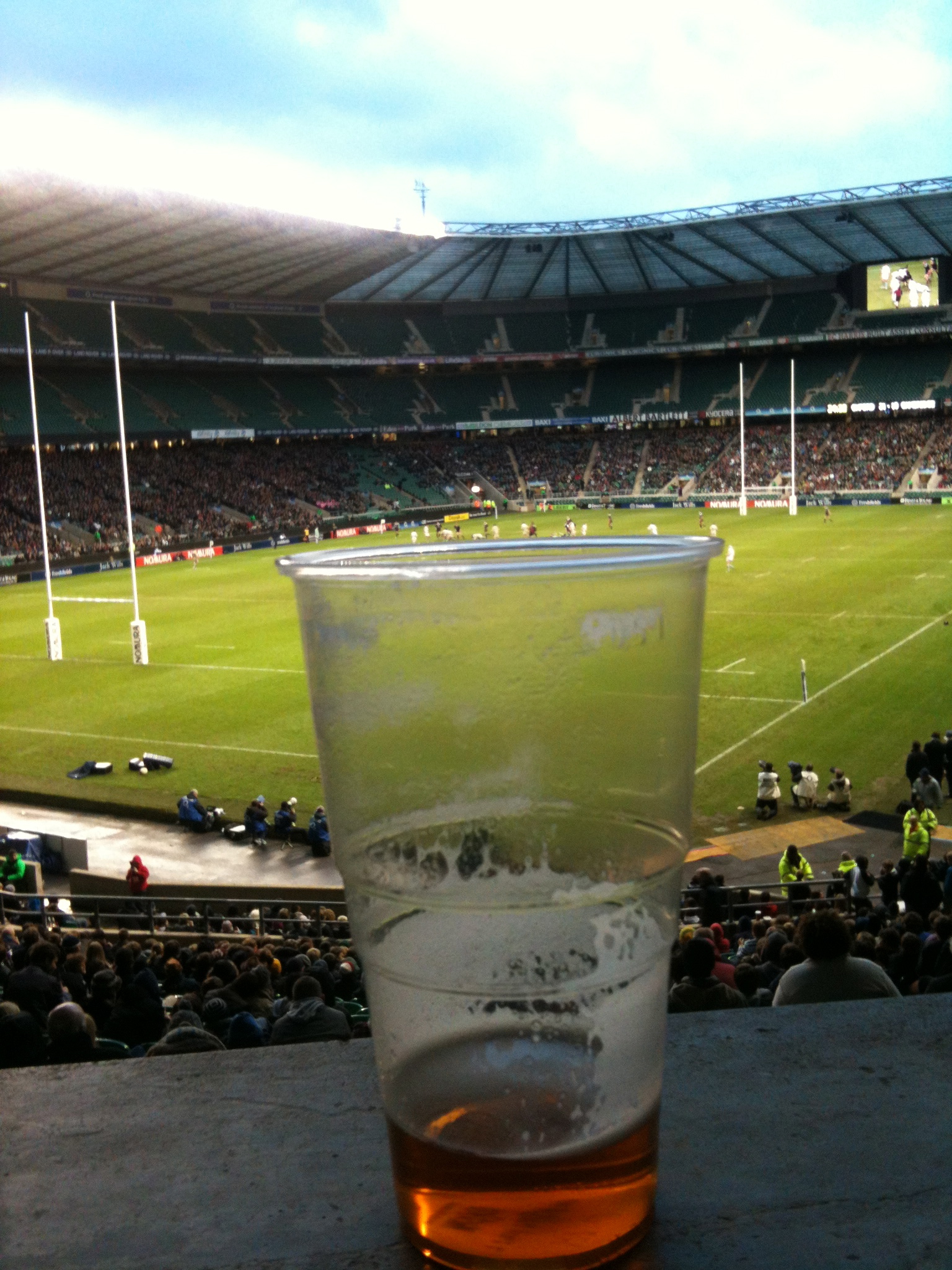
Sorry, its been a quiet week on the Blog front… what with birthdays and colds I have been neglecting you all. Anyhow, yesterday was a brilliant day. A few good friends and I were lucky enough o be invited to the InBev box at Twickenham for the 2011 Varsity Rugby clash between our glorious university, and the other place.

Needless to say the final score reflected the status and standing of the two universities, but was, in reality, a secondary pursuit to that of refreshment.

I am exceedingly grateful to Andrew Hall of the infamous Rose & Crown, Stuart of InBev, Mark and Archie from Marstons, and the spectacularly beautiful dark haired girl on the train who prevented me from attempting to stop the 22:55 Glasgow to London train with the use of ‘the beer force.’

The boys in Dark Blue played well, the Light Blues, well, they turned up. Here’s to them, the vanquished

Leave a comment

Filed under Oxford: The Perspiring Dream

A whisky bottle, a pig’s head, and a blow-up doll…

You have to love ‘news’ stories that involve a whisky bottle, a pig’s head, and a blow-up doll… you could not even make this gem up… and it comes complete with bigoted and erroneous comments below! 

I love the defence lawyers claim that “Sheppard had thrown the bottle in the general direction of the group but had not meant to hit anyone with it.” I wonder how long it took him to conjure that one up… possibly only outdone by the brilliant piece of reporting that one of the group “had a blow-up doll with him and that seems to be the crux of what happened.” Move aside F E Smith and William Boot!

Read the full masterpiece here. Ah Oxford. I love you sometimes…

Leave a comment

Filed under Oxford: The Perspiring Dream

Calling Time on the Periodic Table

I just wanted to share this really excellent interview and article on my undergraduate tutor, Philip Stewart.

Philip, I am sure he will not mind me saying (not that I think he reads this blog) has been almost a grandfather figure to me (and no doubt countless others, including his own!) Time in his company is always uplifting, and his agile, interested and interesting mind is as open as it is resourceful. Anyhow, if you know Philip, I am sure you too will appreciate how highly I respect him.

Philip is a something of a polymath… an academic of the old school, he studied Arabic at Oxford, before taking a second degree in forestry. He then worked as a research officer and lecturer in Algeria, but taught Human Sciences and  Ecology back here till he notionally took retirement in 2006. Since ‘retirement’ he seems to have ever increasing numbers of books and grandchildren, and has recently become something of an authority on the poets of Boars Hill.

One of his most interesting projects has been to re-draw the Periodic Table. Rather than the staid and formal ubiquitous depiction that graces the walls of chemistry labs up and down the country, Philip’s is a spiral that swirls outwards as the number of neutrons increases. As Philip explains, “I conceived a passionate interest in the periodic table when I saw it represented as a huge, colorful spiral in the Science Exhibition of the Festival of Britain in 1951.” The result is not only innovative and accurate, but actually quite beautiful at the same time. You can order a copy for your wall here, or there is a free wallpaper download here.

Leave a comment

Filed under Oxford: The Perspiring Dream, Timology