I like it when disparate things make odd links. I sometimes think that my brain was wired up differently to other people’s… rubbish at linking such important things as strings of telephone numbers or people and their birthdays, but great a connecting obscure facts, places, and snippets of information that normally gather dust in the recesses of our cranial deposit boxes.
Of late I seem to have been bombarded with examples of an obscure form of ceramic type artificial stone. Not your usual musings; I would much rather be thinking about long autumnal walks with Miss Perfect, but for some reason this month fate has chosen to distract me with Mrs Eleanor Coade and her peculiar stone manufacturing process.
A couple of weeks ago an elderly couple I know in Taplow were waxing lyrical about the new gates their neighbours had just erected. Apparently some vandals (and I loved their use of the term ‘vandal’… not thugs or ‘youfs’…they are charming people (the couple, not the yoofs…)) had smashed said gateposts with their wide-boy racing antics, and broken the ornamental vases type things that topped the brick pillars. It transpired that these were made of Coade stone, and were irreplaceable, the ‘recipe’ for its manufacture being lost. Luckily the neighbours had sourced some equally fancy stone finials and the harmony of the village had been restored.
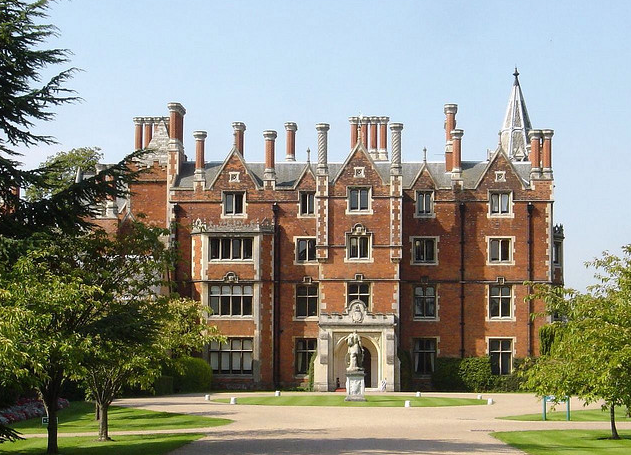
Later that day I was visiting Taplow Court the home of SGI-UK, a lay Buddhist society. SGI-UK is part of a world-wide network of organisations that aims to contribute to a more peaceful and harmonious world through educational and cultural activities based on the philosophy of the 13th century Japanese sage, Nichiren Daishonin. The Victorian pile the group currently operates from is used for courses and conferences and also houses the Library of the European Branch of the Institute of Oriental Philosophy. Hence my interest. However, on the lawn outside was a rather odd but ornate statue of George III dressed as a Roman Centurion. This too turned out to be Coade stone dated 1804.
A bit of detective work has sprung a few surprising finds: It is obviously named after Mrs Eleanor Coade, 1708–1796, who sold it commercially from her new factory in London, Coade’s Artificial Stone Manufactory. I love the fact that this crazy woman found that by essentially baking all this stuff together she could make exquisite statues. Its manufacture required special skills: extremely careful control and skill in kiln firing, over a period of days. This skill is even more remarkable when the potential variability of kiln temperatures at that time is considered. Mrs Coade’s factory was the only really successful manufacturer.
The formula used was:
▪ 10% of grog (sadly not beer, but some sandy stuff…)
▪ 5-10% of crushed flint
▪ 5-10% fine quartz.
▪ 10% crushed soda lime glass.
▪ 60-70% Ball Clay from Devon.
This mixture was also referred to as “fortified clay” which was then inserted after kneading into a kiln which would fire the material at a temperature of 1,100°C for over four days. So its all quite simple really…
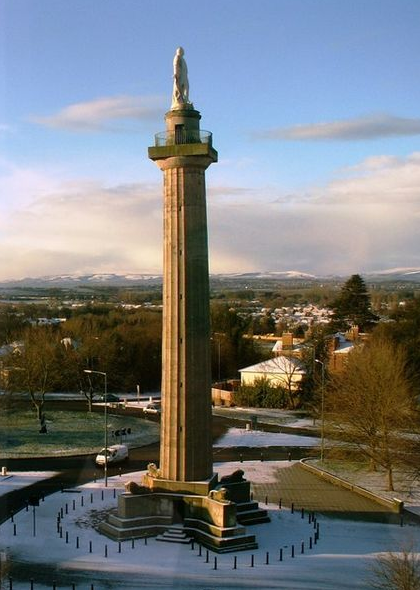
And still the stuff keeps turning up! This weekend I was driving through Shrewsbury on the way back from a fantastically odd party (more of this in another post….) when I turned a corner to be confronted by a truly enormous column in the style of Nelson’s in Trafalgar Square.
Standing at a modest 133 feet it apparently commemorates the 1st Viscount Hill, who was Wellington’s top bod at the battle of Waterloo. His statue sits on the top gazing over the hideous office block that is Shrewsbury County Hall. It is the tallest Doric column in England, which is just as well to see over this monstrosity, and is two feet wider than Nelson’s Column, and 13 feet higher. And I bet you had never even heard of him!
This was never supposed to be a political blog. I am a political creature, but this blog was really just designed to keep me amused, and share my thoughts with those of you that have nothing better to read while you eat your sandwiches at your desk. I have to admit however that a couple of things I have come across in the last week have rather made me think more politically. The usual disclaimers apply; other political ideologies are available, and no fluffy animals were harmed in the creation of this thought process etc etc.
Last week I watched George Clooney’s Good Night and Good Luck that portrays the conflict between veteran radio and television journalist Edward R. Murrow and ‘The Junior Senator from Wisconsin,’ Joseph McCarthy. For those of you not kept awake by American politics of the 1950’s and the Cold War, McCarthy was the leader of a significant and influential sector of the American Government that was obsessively paranoid about widespread Communist subversion. He was noted for making claims that there were large numbers of Communists and Soviet spies and sympathisers inside the United States federal government, military forces, and judiciary. Most of his claims were total speculation and scaremongering, used for political ends, but the atmosphere of fear, mistrust, and paranoia he created lead to the term McCarthyism being used for not only anti-communist activities, but also more generally in reference to demagogic and unsubstantiated accusations, as well as public attacks on the character or patriotism of one’s opponents.
The film itself is interesting; shot in glorious Technicolor, it was colour corrected to black and white while in post production. This results in a really clever ‘feel’ to the movie, in which the actors behave in the way that actors (and presumably ordinary people?) behaved in the 50’s (think thin ties, quick talking, and endless smoking) while the film has the smoothness and picture quality of a modern production. David Strathairn, whom I confess I had never heard of, plays Murrow really convincingly, and I really liked the way the director blended new film with original footage of the trials of accused communists and Murrow’s speech to the Radio and Television News Directors Association in 1958 admonishing them not to squander the potential of television to inform and educate. Again, think Lord Reith, but more American, and less beardy…
The film questions what it is to be American, and to be loyal to the founding principles of the United States. Forgive the lengthy quote, but at one point Murrow broadcasts, “We must not confuse dissent from disloyalty… We will not walk in fear, one of another, we will not be driven by fear into an age of unreason. If we dig deep into our history and our doctrine, we will remember we are not descended from fearful men. Not from men who feared to write, to speak, to associate, and to defend causes that were, for the moment, unpopular… We can deny our heritage and our history but we cannot escape responsibility for the result…As a nation we have come into our full inheritance at a tender age. We proclaim ourselves as indeed we are, the defenders of freedom where ever it still exists in the world. But we cannot defend freedom abroad by deserting it at home.” It’s stirring stuff, well executed, and made me warm again to our friends across the pond.
I was perplexed and angry therefore when I read a piece in last week’s Sunday Telegraph written by Paul Theroux, the well known travel writer and novelist and father of Louis Theroux. I will leave it to your own conclusions to draw parallels between Murrow and young Louis, but I just thought I would throw that one out there. I love Paul Theroux’s books; his ‘Great Railway Bazaar’ is highly evocative, and his ‘Kingdom by the Sea’ captures Britain in a sort of academic Bill Bryson sort of way. It’s well worth a read, and follows his walk in 1982 around the perimeter of Britain capturing Thatcher’s Britain at its social and economic low water mark.
In the article (found here) Theroux described living in America today, and especially in the light of the tenth anniversary of the atrocities committed on September 11th. The America he talked about in his reassuring and conversational way is an uncaring, unquestioning, hurt, and paranoid America that has little understanding of its own authority and role in global affairs. Its long tradition of patriotism is described as being a thin veneer to deeper concerns relating to race and cultural differences. “Politicians have tried to prettify and ennoble the response to 9/11, medals have been awarded, flags flown, but this is patriotism at its most hyperbolic, verging on theatre. What has followed in the 10 years since 9/11 has been a tightening of attention along with its opposite, a sense of despair or indifference.”
The parallels with the America that Murrow accuses McCartney of whipping up are plain to see, and I was not expecting them to be quite so stark, or come from such disparate sources. Theroux writes that, “to Americans today, the world seems hellish and unforgiving. Americans travel less and are fearful of travelling in any Muslim country… Any aggrieved web-savvy Muslim can claim that at the highest levels of the US government, many Americans – politicians, so-called Neo Cons, cabinet members, operatives – hold dual US-Israeli citizenship. Americans are not allowed to be dual citizens of Iraq, Iran, Syria, Pakistan or any other Muslim country… It is perhaps melodramatic to say Americans are living in an age of fear. Because no one can stand much strength-sapping tension for very long, we have become exhausted, dispirited and small-minded, living through a period of inexpressible self-induced dullness, with a subtext of fear and uncertainty that is reflected in all phases of life.” This is surely not the same America that shines a beacon for “your tired, your poor, Your huddled masses yearning to breathe free, The wretched refuse of your teeming shore.”
As I said, this is not supposed to be a political blog, but I don’t want to find myself in a world where fear, suspicion, and terror are the primary motivating influences. Perhaps it is time that America (and for that matter, the UK) begins to acknowledge The Palestine as an independent state and not continue to veto its application to join the UN. Perhaps it should be possible for Americans to have dual citizenship with some God fearing, but Muslim, nations. Perhaps we as individuals should think about how we have allowed fear to infiltrate our lives rather than expect our governments to defend us from all dangers and perils of this night. Perhaps we need more Murrows and Therouxs to make us realise what is done in our names. But more than that, perhaps we all need a little more trust in one another. Oh, and another cup of tea.
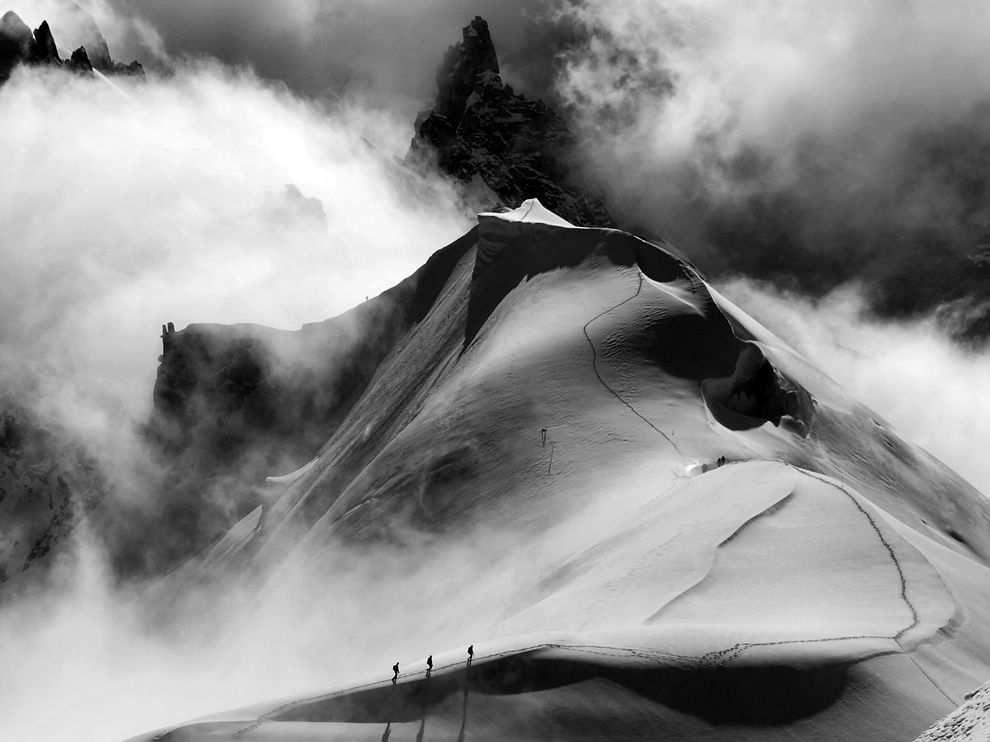
I just really wanted to share this image with you all. It was taken by Tommy Harris. It is one of the National Geographic’s ‘photo of the day’ collection.
I have always loved National Geographic; its articles are always intelligently written, but the photos have always been by far and away ahead of the mainstream. There is no rhyme nor reason for the selection for photo of the day, but I use them as my background images to keep me interested and entertained. Even as a kid I remember gawping at their images, and even now in a technical, digital, and travel photographer friendly age, their images are something special. This one is called Alpine Climbers, Midi Plan Traverse, France.
For each of the images they also add some photographer’s tips and notes on how to compose images etc. I dont have a swanky digital camera… I have always coveted a digital SLR, but they have always been a bout beyond my price range. Cunning or regular observers of this blog (I flatter myself I know…) will notice that all the photos I have taken are from my iPhone, and normally have my thumb somewhere on the bottom left… but I like to read the tips anyhow. I thought you might like them too! You can find all the back catalogue and photo of the day here.
For this image Catherine Karnow comments: When I was a novice photographer, I learned from my mentor that a successful composition should lead your eye around the frame in a graceful curve. So it is with this remarkable landscape of swirling clouds, sun, and mountains. The contrast between the soft, gentle, snowy slopes and the sharp, jagged black peaks makes me feel both seduced and afraid, which is surely how a mountain climber must feel.
We first notice the three climbers. Tiny, they show us just how towering these peaks are. They are like the all-important first notes to a grand and bold symphony. We then follow the climbers’ tracks, which trace the same elegant shape of the snowy ridge. The eye then climbs up toward the middle peak at dead center top, then finally to the upper left of the frame. That movement is key to the success of the composition.
I know its not normal to get excited about plug sockets, three pin plugs, and gang plugs, but this little gismo really impressed me.
I have often wondered why the British use the traditional three pin plug, or for all you pedants out there, the G type BS 1363 (British 13 A/230-240 V 50 Hz grounded and fused).
Not only is it ugly, clunky, and an outdated 1940’s design, but like buttered toast it always lands wrong side up, eagerly awaiting the soft underbelly of the soles of your feet while you wander about trying not to trip over the blasted thing. When you put your laptop in your backpack to cycle home they also always end up digging into your back, or scratching the polished aluminium casing of your prized electronic hardware.
You get the picture; I am not a fan, and I bet now you have read this, you too are wondering why we bother… I guess its just that they so ubiquitous there is a certain lethargy to change the design. ( it is a sad fact that they are used not only in the United Kingdom, but also in Pakistan, Ireland, Sri Lanka, Maldives, Bahrain, UAE, Qatar, Yemen, Oman, Jordan, Cyprus, Malta, Gibraltar, Botswana, Ghana, Hong Kong, Macau, Brunei, Malaysia, Singapore, Indonesia, Bangladesh, Kenya, Uganda, Malawi, Nigeria, Mauritius, Iraq, Kuwait, Tanzania, Zambia and Zimbabwe. So there all you continentals and Americans sporting smug grins.) If it aint broke, dont fix it.
However a young designer called Min-Kyu Choi has shown off a brilliant new replacement option at The Royal College of Art‘s graduate show that opened this week. His neat, and market-ready plug that folds down to the width of an Apple MacBook Air.
Anna Bates of IconEye Magazine notes, “Choi’s plug is just 10mm wide when it is folded. To unfold it, the two live pins swivel 90 degrees, and the plastic surround folds back around the pins so the face of the plug looks the same as a standard UK plug. The idea produced a spin off, too. Choi created a multi-plug adaptor, a compact standard plug sized unit with space for three folded plugs to slot in, as well as one that charges USB devices.” Read her review here.
I love how this chap has taken to task the most obvious poor link in the chain of elegant design; while manufacturers spend millions designing your phone, computer, laptop, hand held device, and almost every electronic piece of hardware, none has had the vision or realisation to tackle the ugly grey lump at the end of the the cable. Hats off to Choi!
The annual ‘Astronomy Photographer of the Year Award’ is run by the Royal Observatory Greenwich and Sky at Night Magazine… again, not my usual reads. However the BBC news site has put together one of their ‘captions to music with someone explaining whats going on voiceover type features’ that are compulsive reading on a quiet Friday afternoon on POETS day. (Piss Off Early Tomorrow’s Saturday.)
The BBC explains; “From giant oval storms on the surface of Jupiter to colourful wispy remnants from a supernova explosion and the dazzling green curtain of the Northern Lights – nearly 800 images were submitted for the latest Astronomy Photographer of the Year competition.” One image stood out for me… the sun setting over our fair city. So with the obvious rider that I did not take this image, and have borrowed it from whoever did etc etc other Astronomy Photographer of the Year Awards are available etc etc etc, here it is:
I am a self confessed Apple Mac fan. I love their intuitive design, elegance, speed, robust software, tibetan fonts, and downright sex drive.
I really don’t understand all the legal battles that are going on between Apple and their competitors over design and processor issues. Apple seem to be involved with legal disputes with HTC, Nokia, and Samsung all at the same time. They can afford all their legal fees as they currently have more money than the American Government, and even recently received my own humble contribution to their coffers (in exchange for a laptop.)
Anyway this is all by the by. In an amusing twist to the legal battle over design patent issues for the iPad, Samsung have cited Stanley Kubrick‘s masterpiece Space Odyssey 2001 as an example of prior art for Apple’s iPad design patent. I am sure that not all of their cunning defence case rests on this one clip, but it is remarkably alike to the untrained eye (I dont have an iPad, and have not seen the film for years…)
The Star Trek geeks out there also claim that one of the pointy eared brigade also uses an iPad type device in the early episodes, but you will have to pop into your local speed-dating night in the Town Hall or any Liberal Democrat Regional Office to confirm this.
Last week I was lucky enough to be able to actually attend one of my good friend Theo Jackson’s live jazz gigs. I have known Theo for years now, and have always been aware of and enjoyed his brilliance behind a piano, but its rare that I actually ever get to one of his gigs; Stuck out here in provincial old Oxford away from the hubbub of the metropolitan Jazz Scene I have somehow missed all of his recent gigs. He continues to invite me, but I suspect harboured the creeping doubt that I was a member of the “I want to do that” clan that never actually get round to doing ‘that.’ But I made it, and what a gig!
Theo is a muso who studied music in Durham, who in the last few months has played such prestigious venues as Ronnie Scotts’, The 606 Club, and the Pizza Express Jazz Club. Last week he played in the Church at St Michael of the North Gate, Oxford. The atmospheric lighting, surrounds, and fabulous acoustics were utilised brilliantly, and the harsher sounds of Nathaniel’s alto sax mixed well with Theo’s piano and the warm cans of beer on sale at the back of the church.
If you do get a chance to go and see them both live, its well worth the effort. Even if it means a trip to the metropolis.
You can get all Theo’s details, videos, and details of future gigs here.





 Tim Myatt