Category Archives: Timology

An Apathy for Antiquity

I am often taken aback by the sheer volume of history that we have in this country, and also how staggeringly neglectful we are of our embarrassment of heritage. I am not going to descend into a Daily Mail style rant about our failings to teach ‘proper‘ history in our schools, or our total lack of grasp of facts and figures, but just how absent mindedly we treat our past.

I guess a certain amount of this sequent slovenliness comes from the sheer volume of ‘history’ that we are surrounded with. Bill Bryson in his Notes From a Small Island expresses his amazement that in the UK there are (or were at his time of writing in 1995) 445,000 listed historical buildings, 12,000 medieval churches, 1,500,000 acres of common land, 120,000 miles of footpaths and public rights-of-way, 600,000 known sites of archaeological interest. Most memorably me marvels that in his Yorkshire village there were more 17th-century buildings than in the whole of North America.

So it’s not surprising that some of this plethora of past achievement and industry gets nibbled away each year. We also have a grand tradition of the occasional bonfire of beautiful buildings, take for example the Black Death, Dissolution, Reformation, occasional visitations from the Luftwaffe, or the frankly criminal machinations of the 1960’s town planner. But still there are the occasionally baffling examples of historical indifference. I found one such example the other day.

Despite being one of our better known Saints, a former Archbishop, and medieval martyr, there are almost no chapels or churches dedicated to St Thomas a Becket. The obvious exception to this was his famous shrine in Canterbury Cathedral, but that was destroyed in 1538 when Henry VIII ordered that  Becket’s bones be destroyed and  that all mention of his name be obliterated. Oh, that, and the famous shrine at St Thomas’ Chapel in Meppershall

What?! You have never heard of the famous shrine at St Thomas’ Chapel in Meppershall? Tsk Tsk… “As any fule kno” the chapel is first documented in a papel letter dated 1291 which promised to all penitents the remission of one year and forty days penance if they made the pilgrimage to the chapel of St. Thomas the Martyr. It belonged to the Gilbertine Priory at Chicksands which had been founded by Rohesia and Payn de Beauchamp around 1150 (more here). The chancel was mainly replaced in around 1500, but there is some staggering twelfth century sculpture found on the south doorway. Still not ringing any bells? No? Well, I am not surprised…

It is used as a cow shed.

St Thomas' Chapel in MeppershallOn an ‘interesting’ final note, legends attached to the chapel are many, but one tells of a man called “The Jiggler” who hanged himself there and was buried in a grass triangle where the water tower now stands. It is said that if you walk around the triangle twelve times at midnight, The Jiggler will come out after you. So, who is up for a trip to Meppershall?

Leave a comment

Filed under Timology

Guess Who Friday!

Yes; It’s Guess Who Friday.

But lets keep it classy; no tabloid nonsense. And no switching parties… it’s not like we are trying to teach Auntie to play football…

G

Leave a comment

Filed under Timology

A More Cunning … Guess who Friday!

I have been neglecting our weekly “Guess Who Friday” feature… mainly because I have not been around on a Thursday evening to find favourably fiendish photographs. My apologies. But this one might just make up for it.

And before you all smile knowingly and say, “well that’s that nice young Mr Tennant, you know, the one off Dr Who...” it is not him that I am after. It’s the chap on the right of the picture. Yes, the dead one. (And “Alas, poor Yorrick” is also not an answer; you smug so-and-sos…)

Usual rules apply… no cheating, and answers on a PM, email, or text message!

skull

BTW, I should make clear that this is in no way a “Halloween Special.” You can put your pathetic attempt at a ‘sexy zombie’ costume away. Please.

2 Comments

Filed under Timology

A Cathedral of Crap

I am sure that you are by now aware that I have a soft spot for all things Victorian and loony… after all, I spent five years researching a man who invaded Tibet in 1903, ended his days believing in space aliens, and wrote books with catch titles like, ‘Life in the Stars: An Exposition of the View that on some Planets of some Stars exist Beings higher than Ourselves, and on one a World-Leader, the Supreme Embodiment of the Eternal Spirit which animates the Whole.’ (Younghusband:1927).

I also find Victorian architecture and design fascinating… for a people that believed that the world’s largest Empire could be run with little more than a black top-coat and a Bible, they produced some remarkably ornate and beautiful buildings. If austerity and moral high mindedness were the touch stones of their epoch, then absurdity and high gothic ornamentalism were the foundation stones of their architecture. The list is endless but think of the great railway stations in London (St Pancras, and the Gilbert Scott especially), The Natural History Museum, and Keble College Oxford to name but a few.

But these are all buildings designed to impress, and to flatter their visitors and inhabitants. Perhaps my favorite Victorian building is however none of these… it was built for an entirely different purpose. Some might say for a slightly shitty purpose; it is the pumping station at the far east end of the Great Southern Outfall Sewer, in Bexley, London. It is called the Crossness Pumping Station, and it’s a real hidden gem.

Designed by the Metropolitan Board of Works’s Chief Engineer Sir Joseph Bazalgette and architect Charles Henry Driver it was built between 1859 and 1865,  expanded in 1897, and again in 1901. It was so ornate and beautiful that, in what must have been the most bizarre invitation card of the century, it was officially opened HRH the Prince of Wales, attended by Prince Alfred, the Duke of Cambridge, Prince Edward of Saxe-Weimar, the Archbishop of Canterbury, the Archbishop of York, and the Lord Mayor of London.

Yep, they got the Prince of Wales, two further Royal Princes, two Archbishops, and the Lord Mayor to open a sewerage pumping station… now do you get an idea how ornate it is? Following that, in the true Victorian spirit, the “Prince and five hundred guests sat down to an excellent dejeuner, in one of the ancillary sheds, beside the Engine House.” One can only imagine the sheer bonkerness of the whole scene, but Nikolaus Pevsner, never one to shower praise, described as “a masterpiece of engineering – a Victorian cathedral of ironwork.”

But the beautiful behemoth had a rather grim purpose; to pump the sewerage from the great drain into a reservoir for basic treatment, before it was released into the Thames as the tide ebbed out towards the sea. Lovely. The four massive coal fired steam engines, the largest rotative beam engines in the world, with 52 ton flywheels and 47 ton beams, lifted 6 tons of sewage per stroke, per engine, up into a 27-million-imperial-gallon reservoir. Basically it moved a lot of shit.

800px-The_Octagon,_Crossness_Pumping_Station The following description of the building comes from the current website: “The complex was designed in the Romanesque / Norman style, in gault brick, with considerable ornamentation with red brick arches and dog-tooth string courses. The three entrance doorways were decorated with Norman dog-toothed red brick arches, whilst the main entrance, facing the river (now hidden by an extension) was further decorated with the coats-of-arms of the MBW and adjacent counties. There was originally a magnificent chimney, 207 feet high, which has since been demolished.

The capitals of the many columns and mullions on the outside of the building and the supporting corbels to the arched overhanging main cornice, are of different designs, and although some of these are repeated, no two side-by-side, are alike.

The interior of the Engine House was provided with wrought and cast iron work of the most ornate design. The four engines are placed in the corners of the building, the centre of which is occupied by an octagonal structure of iron columns with richly ornamented capitals, supporting iron arched screens and the open octagonal well on the main beam floor. Handrails were of tubular brass highly polished, and the ironwork was painted in natural colours following those of the leaves, branches and fruit represented. The openwork upper iron floors were painted in french grey and vermilion, whilst the shafts of the main columns were in indian red. The elaborately painted panels in the octagon, immediately below the beam floor, incorporated the monogram of the Metropolitan Board of Works, the same device being included in the centre of the cast-iron screens on the working floor.”

Sadly, when the pumping station was decommissioned in the 1950s it was not considered economic to dismantle the engines as the cost of doing so far exceeded any scrap value. The more valuable metal items (made from brass) such as the engine oilers, much pipework and even the handrails from the stairs were removed. The remaining building and engines were left to suffer considerable vandalism and decay. However the good work of the Crossness Engines Trust has lead to many of the buildings, engines, and ornamental features being restored and opened to the public. Sadly, it is not open next until April 2014, but you can find out more information here.

Crossness

1 Comment

Filed under Timology

Shantaram: Seven Pillars of Wisdom with James Bond

I have just finished reading Shantaram by Gregory David Roberts.

My father first recommended the book to me years ago after he read it on holiday, and a few months ago I was instructed to read it by a lady. Given my preoccupation with all things India, love of a good book, and how well both the story sommeliers know me, I decided to finally broach the behemoth. And it is quite the monster of a book… 930 pages, with not even a picture to keep me entertained.

As you may have gathered from this blog, and those that know me, I am normally a fairly binary character; I know what I like (gin, electroswing, port meadow) and what I don’t like (dill, Cornmarket, vermouth) but this one has left me stumped. Not, to push the cricketing analogy, Myatt. 33. Caught and bowled, Roberts. But more stumped; playing forward to one that turned more than expected.

Let me explain. I know I should have loved this look. I wanted to love this book. The fact that I was lent dad’s battered copy of a book nearly 1000 pages long all about India, should have been enough. The fact that someone, more dear to me than she knows, shoved a note in my pocket telling me in bold capitals that I was a fool not to have read it, was reason enough. The fact that I read it on my first holiday in years shows that I was willing to accept the page turning marathon. And in truth, I did love it. But only in parts.

33600 copy

The main character in the book, Lin, is almost subservient to what is best described as “Mother India.” I loved the descriptions of her cities, villages, people, bustle, and vibrancy. If you have been to the sub-continent, you will know exactly what I am talking about. The fact that she grips you, assaults you, and demands the full attention of every one of your senses is an almost ubiquitous, but bewildering, realisation that you are already in love with her. The time Lin spends in the slums and coffee shops of Bombay are the most convincing and compelling parts of the book. You sit with him in the wicker bucket seats at Leopold’s, help him to mend the tin roofs ahead of the monsoon in the clinic, and watch in horror during the beatings at the Arthur Road Prison. (Incidentally you can visit most of the sites in the book with one of the ‘real’ characters. See here.) Roberts’ descriptions of the major characters are very human and believable. For the most part the book ticks along at a good pace, and despite its focus on brutal violence and complex criminals it is an enjoyable read. The twists are spread evenly enough throughout the book to keep you interested, even if they hove sluggishly into view pages before they are executed.

However I have some reservations about the book. The vast majority of the characters are poorly developed. We learn a lot about them, but they add very little to the book. For example, we are provided with personal descriptions and life stories of each of the mujahideen fighters as they battle through Afghanistan, but their actions and role in the development of the plot is limited. This could be for one of two reasons, either Roberts loves the sound of his own descriptive narrative, or they were all real people who profoundly affected his life and he wanted to memorialise them in this way. Roberts has claimed that the book is semi-autobiographical; and certainly there is enough evidence not to doubt his assertion, but this does sometimes lead to frustrating narrative cul-de-sacs. This is (increasingly, and lamentably) acceptable in a serialisation, but indulgent in a 1000 page single volume. Aside from the three main characters the cast list is a touch cartoon… everyone is an extrovert who has two, or at most three, defining features. Karla for instance has a green eyes, a great body, and Lin loves her; but despite the love being constantly examined in a nauseatingly introspective way, it is never explained or convincing. I don’t agree with the accusations from some quarters of inherent racism, but the number of characters could be halved, their intensity doubled, and the book would, IMHO, be much the better for it.

Lin, or Roberts, clearly is his own biggest fan. Chapters are devoted to his looks, charm, linguistic abilities, athleticism, humility, cunning, bravery, and admittedly his flaws, addictions, and criminality. It can be best described as self obsessed. The way Lin is ‘at ease’ with everyone, but ill at ease with himself hints at a darker narcissism, but the constant introspection of the main character is a bore. The very name, albeit a moniker, Shantaram means ‘man of peace,’ and it is hard to imagine others so hubristically accepting and using the title. The nascent philosophy are at the same time a welcome relief, and vaguely irritating. The development of the debate between Lin and his mentor and father figure regarding ethics and intention of action provides a second dimension to the book, but it is hardly a balanced introduction to Deontology or Consequentialism. Kant too thought  it possible to develop a consistent moral system using reason alone, but his theory glimmers here rather than shines, eclipsed by the star of the semi-autobigraphical show.

Basically I wanted too much. I wanted the Seven Pillars of Wisdom with James Bond. What we have is an fantastically engaging, gripping, page turner, that will make you smile and your stomach turn at the same time. However, and alas, it is no modern Arabian Nights… that said, if you do know of one, please do tell me!

4 Comments

Filed under Timology

The Fair Queen and St Giles

Oxford has this week been turned over to the annual St Giles’ Fair. It has been the traditional riot of lights, colour, and smells (some good, some less so)… I always feel that it is such a shame that the fair is not held when the students are in term and can also enjoy it; however given that its history goes back to pre 1200, I guess the fair has precedence over the undergrads!

A couple of interesting snippets about the bonanza of bright lights and booze: I has enjoyed Royal patrons in the past, indeed, when Elisabeth I stayed in Oxford between 3–10 September 1567 she watched the fair from the windows of St John’s College on the east side of St Giles’. I bet she did not go on the dodge’ms though…

Traditionally, anyone with a beershop was allowed to bring barrels of beer to St Giles’ Fair for sale. The great Wikipedia also tells me that another custom was that any householder in St Giles itself could sell beer and spirits during the fair by hanging the bough of a tree over their front door. Next year I am going to make a fortune flogging gin and beer with only the help of a hanging bough!

St Giles' Fair

Leave a comment

Filed under Oxford: The Perspiring Dream, Timology

The Lion Sleeps Tonight

Just occasionally I find little gems of musical interest, and feel compelled to share them with you… I have what was once described as a “catholic” taste in music (note, small ‘c’… I don’t listen to Ave Maria over and over…) and I think it’s fair to say that this one is somewhat ‘off piste’.

This was recorded in 1939, as World War II broke out,  but “Mbube” (the Zulu word for Lion) was written in the 1920s by the delightfully names Solomon Linda. Solomon was a Zulu South African singer, who worked for the Gallo Record Company as a cleaner and record packer. He also sang performed part time with a choir, The Evening Birds, who form the backing vocals in this recording.

Many of you will recognise the song as the basis for ‘The Lion Sleeps Tonight‘ recorded over the years by many artists, but made famous by The Weavers, and also by Ladysmith Black Mambazo. For his 1939 performance of ‘Mbube’ Linda was paid a small fee. Gallo Records of South Africa reaped all the royalties of the record sales in South Africa and Great Britain. The record, through its subsequent incarnations went on to reap over US$15 million in royalties from covers and film licensing (think The Lion King…) However the sad fact remains that Linda received virtually nothing for his work and died in 1962 with $25 in his bank account.

A long and complex legal battle ensued. Linda’s heirs claimed that they had received less than one percent of the royalties due him from Abilene Music Publishers and that Disney owed $1.6 million in royalties for the use of ‘The Lion Sleeps Tonight‘ in the film and musical stage productions. In February 2006, Linda’s descendants reached a legal settlement with Abilene Music Publishers, who held the worldwide rights and had licensed the song to Disney, to place the earnings of the song in a trust. That trust continues to do stirling work with Zulu musicians.

Leave a comment

Filed under Timology

Holi Smoke (stack)

Do check out these great photos from the Holi festival at Battersea Power-station earlier this month.

Holi is the Hindu festival that heralds the arrival of spring on the subcontinent, and is traditionally celebrated by showering your friends and family (indeed anyone you come across) with brightly coloured powder. It’s enormous fun, but the powder does seem to find its way into the strangest places! Check out the rest of the photos here.

Battersea Holi

Leave a comment

Filed under Photography, Timology

Lying about the lion

This little gem has made the inside pages around the word this week as a Chinese zoo’s supposed “African lion” was exposed as a fraud. The dog that the zoo had used as a substitute started barking… raising eyebrows and suspicions that it might not actually be a lion.

The zoo in the People’s Park of Luohe, in the central province of Henan, replaced exotic exhibits with common species, according to the state-run Beijing Youth Daily.

It quoted a customer named Liu who wanted to show her son the different sounds animals made – but he pointed out that the animal in the cage labelled “African lion” was barking.

The beast was in fact a Tibetan mastiff – a large and long-haired breed of dog. lion dog

In a rad faced interview the the chief of the park’s animal department, Liu Suya, told the paper that while it does have a lion, it had been taken to a breeding facility and the dog — which belonged to an employee — had been temporarily housed in the zoo over safety concerns.

I think he might be lying, especially as the zoo was also found to have two coypu rodents in a snake’s cage, a white fox in a leopard’s den, and another dog in a wolf pen. Barking mad if you ask me.


Leave a comment

Filed under Tibetology, Timology

Awkward Positions.

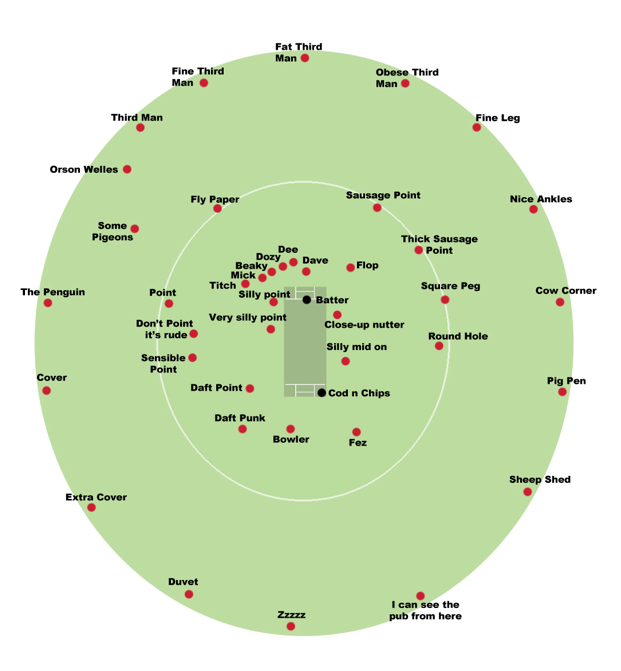
I bet you have always wondered where the various cricket positions are located around the field when you have been listening in on the radio. Well here is a helpful guide:

Cricktpositions

1 Comment

Filed under Timology