
This is the most awesome footage created by time lapse sequences of photographs taken by the crew of expeditions 28 & 29 onboard the International Space Station from August to October this year. The photos were taken at an altitude of around 350 km above the earth, gobsmacking enough, but the images that capture lightening and the green Aurora are just amazing.
More on the Tibet situation
Briefly, here are two further perspectives on the sad trend of self immolation in Tibet, one by a Tibetan author, and the other by the Dalai Lama himself on the BBC.
Filed under Tibetology

Anarchqueen
I thought this was funny enough to repost. Cant remember where its from…
Filed under Photography
Calling Time on the Periodic Table
I just wanted to share this really excellent interview and article on my undergraduate tutor, Philip Stewart.
Philip, I am sure he will not mind me saying (not that I think he reads this blog) has been almost a grandfather figure to me (and no doubt countless others, including his own!) Time in his company is always uplifting, and his agile, interested and interesting mind is as open as it is resourceful. Anyhow, if you know Philip, I am sure you too will appreciate how highly I respect him.
Philip is a something of a polymath… an academic of the old school, he studied Arabic at Oxford, before taking a second degree in forestry. He then worked as a research officer and lecturer in Algeria, but taught Human Sciences and Ecology back here till he notionally took retirement in 2006. Since ‘retirement’ he seems to have ever increasing numbers of books and grandchildren, and has recently become something of an authority on the poets of Boars Hill.
One of his most interesting projects has been to re-draw the Periodic Table. Rather than the staid and formal ubiquitous depiction that graces the walls of chemistry labs up and down the country, Philip’s is a spiral that swirls outwards as the number of neutrons increases. As Philip explains, “I conceived a passionate interest in the periodic table when I saw it represented as a huge, colorful spiral in the Science Exhibition of the Festival of Britain in 1951.” The result is not only innovative and accurate, but actually quite beautiful at the same time. You can order a copy for your wall here, or there is a free wallpaper download here.

Filed under Oxford: The Perspiring Dream, Timology
A Terrifying Trend: Self-immolations in Tibet
Finally the US has found some voice of protest concerning the current, horrifying, trend of self-immolations in Tibet over recent weeks. For more news on one such recent protest follow this link, and sadly there have been many such instances in the last few months. U.S. Secretary of State Hillary Clinton used the occasion of the Asia Pacific Economic Cooperation forum to address the issue saying that the US was, “alarmed by recent incidents in Tibet of young people lighting themselves on fire in desperate acts of protest… We continue to call on China to embrace a different path.”
“We have consistently and directly raised with the Chinese government our concerns about Tibetan self-immolations, and we have repeatedly urged the Chinese government to address its counterproductive policies in Tibetan areas that have created tensions and that threaten the unique religious, cultural, linguistic identity of the Tibetan people. We’ve also repeatedly urged the Chinese government to allow access to all Tibetan areas of China for journalists, diplomats, and other observers so that we can get accurate information and so that you can get accurate information.
“And let me take this opportunity to again call on the Government of China to respect the rights of all of its citizens who peacefully express their desire for internationally recognized freedoms, and particularly the rights of Tibetans to resolve their underlying grievances with the Government of China.” These quotes come from the International Campaign for Tibet, and more can be found here.
I should declare my interest in this sorry situation; While I was an English teacher in the small monastery of Dip Tse Chok Ling in Dharamsala I lived in the former cell of Thupten Ngodup (pictured), the former cook and cow herder of the monastery.
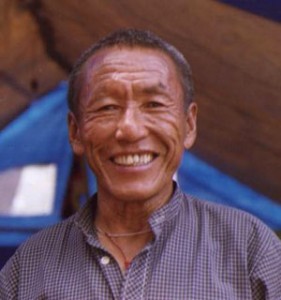
It was in 1998 in Delhi that the Tibetan Youth Congress organised a ‘Hunger Strike unto Death’ to pressure the United Nations to implement the International Commission of Jurist recommendation of 1997 report on Tibet. The first batch of hunger strikers consisted of six members of TYC, but the demonstration was disrupted and broken up by the Indian police on their forty-ninth day of fasting. Thupten was part of the second batch of hunger strikers, and set himself alight on 29th April, 1998. Accounts of his death vary, but one, harrowing one, is based on filmed evidence, and can be found here (warning, its not comfortable reading):
“A video shot by Choyang Tharchin of the Department of Information and International Relations (DIIR) shows Thupten making his way to the public toilet. He opened a plastic container of gasoline, which he must have hidden there earlier, and dowsed himself thoroughly. Then he struck a match or flicked a lighter. .. When he came out he was, quite literally, an inferno. The DIIR video makes that horrifyingly clear. We see him charging out to the area before the hunger-strikers tent, causing chaos in the ranks of the police as well as the Tibetans there. A very English female voice — off camera — screams’ “Oh my God” Oh My God” again and again. With that and other screams and shouts, it is impossible to hear what the burning man is saying. According to someone there he shouted “Bod Gyal lo” or “Victory to Tibet”. Others heard him crying “Bod Rangzen”, or “Independence for Tibet.” He also shouted “Long live His Holiness the Dalai Lama”. How on earth he managed to shout anything, much less run about as he did is a mystery to me. Every breath he took must have caused live flames to rush into his lungs and sear the air sacs and lining.
The burning man then appears to pause and hold up both hands together in the position of prayer. At this point the fire seems terribly intense and the cameraman later remarked that he could distinctly hear popping sounds as bits of flesh burst from Thupten Ngodup’s body. The cameraman was so shaken he found it difficult to hold his camera steady. Then policemen and Tibetans beat at the flames with rugs and sacks, and finally pushing Thupten Ngodup to the ground, stifled the blaze.” 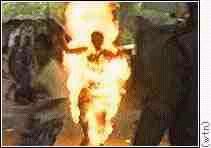
I moved into his small cell only a few months later in late 1998. People often ask me why I ended up studying Tibet; why something quite, so, well, pointless? I guess living in such a monastery and community had a profound effect on me, and planted a small seed that really has only begun to germinate. More important, and sad, is that the situation that lead Thupten to set himself alight is still prevailing.
While the international finger pointing goes on, with the Chinese news agencies bitterly criticising the Dalai Lama for not condemning the protests, and the Tibetan Government in Exile urging restraint and dialogue, one thing is for sure, I fear that this distressing and despairing trend will sadly continue.
Filed under Tibetology, Timology
A Right Royal Mess….
In a moment of rare good humour, the Telegraph has printed something that could be construed as being slightly anti-monarchy; a picture of a ceramic caricature of the Duchess of Cambridge, well, defecating, might be the most appropriately royal word.

A traditional “caganer” ceramic figurine of Catherine, Duchess of Cambridge is pictured in Torroella de Montgri, Northern Spain. Statuettes of well-known people defecating are a Christmas tradition in Catalonia, dating back to the 18th century. Catalonians hide caganers in Christmas Nativity scenes and invite friends to find them. The figures symbolise fertilisation, hope and prosperity for the coming year. I bet these are to be pictured on the Wills and Kate’s Christmas cards this year….
Filed under Timology
The devil is in the detail…
So, if you ever needed reminding why Tibetology, and the detailed analysis of Anglo-Tibetan relations, is important and relevant, here it is: The world’s two largest nations, accounting for about 1/3 of the global population, both armed to the high teeth with nuclear weapons and global ambitions, having an undignified and unfortunate scrap about Tibetan border areas, and the much disputed McMahon Line.
As the article points out, “China, India’s largest trading partner, claims sovereignty over parts of Ladakh and Arunachal Pradesh and calls it southern Tibet. It refuses to recognize the “imperialist” 1913 Shimla Convention under which Tibet ceded Tawang to India and regards its border with India – the McMahon line – as disputed.”
The McMahon Line is a line agreed to by Great Britain and Tibet as part of Shimla Accord, a treaty signed in 1914. Although its legal status is disputed by China, it is the effective boundary between China and India. The line is named after Sir Henry McMahon, foreign secretary of British India and the chief negotiator of the convention. It extends for 550 miles from Bhutan in the west to 160 miles east of the great bend of the Brahmaputra River in the east, largely along the crest of the Himalayas. The Shimla Convention was a disputed treaty concerning the status of Tibet negotiated by representatives of China, Tibet and Britain in 1914. The Simla Accord provided that “Outer Tibet” would “remain in the hands of the Tibetan Government at Lhasa.” This region, approximately the same as today’s Tibet Autonomous Region, would be under Chinese suzerainty, but China would not interfere in its administration. Not that it really matters, the Chinese delegation walked away, and never recognised or ratified the treaty. 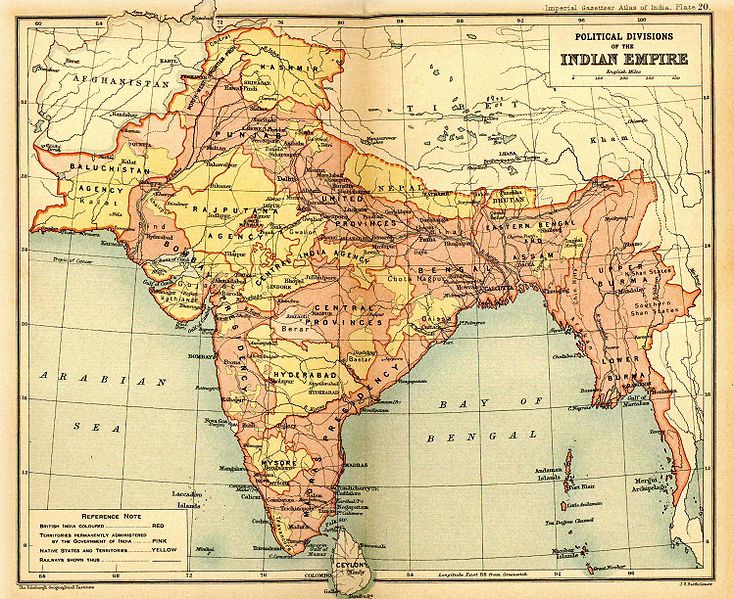
This spat is important as, while the article is written from an Indian perspective, national pride and tender toes are still evident in the region following a series of disastrous wars in the 1960’s between India and China over the border regions. I do like the reporting that the Chinese ambassador told the journalist to “Shut up!” … however I doubt those were his exact words!
Filed under Tibetology
The First Arab Revolt
Ok, so after an entirely flippant, but amusing, picture of an item of kitchenalia shaped like a willy, something of a different nature. Yesterday I stumbled upon this image, and instantly fell in love with it… Its called ‘On the Aerodrome at Amman.’ It was taken during a series of meetings between British, Arab, and Bedouin officials in Jordan during April 1921.
The nervous looking chap in the serge suit is none other than T.E. Lawrence, ‘Lawrence of Arabia’ who looks entirely ill at ease with his attire and company; Sir Herbert Samuel is the moustache under the white pith helmet, and Amir Abdullah is the wily looking chap with the golden dagger. The image is part of American Colony Jerusalem Collection at the U.S. Library of Congress.
However while Samuel dominates the photo, and Lawrence dominates the lore and history of the period, the most interesting part of the photo is in the far left of the image… the lady in the purple hat. I think its Gertrude Bell, but can not be sure.
 And if you don’t know who Gertrude Bell was, well shame on you! She was a writer, traveller, political officer, administrator, and archaeologist who explored, mapped, and became highly influential to British imperial policy-making due to her extensive travels in Syria, Mesopotamia, Asia Minor, and Arabia. Her main achievement was that along with Lawrence, she helped establish the Hashemite dynasties in what is today Jordan as well as in Iraq. She played a major role in establishing and helping administer the modern state of Iraq, utilizing her unique perspective from her travels and relations with tribal leaders throughout the Middle East. During her lifetime she was highly esteemed and trusted by British and Arab officials and given an immense amount of power for a woman at the time.
Alike to Lawrence in many ways, she has also been described as “one of the few representatives of His Majesty’s Government remembered by the Arabs with anything resembling affection.” (I admit to having lifted some of this bio from Wikipedia.) If you get a chance, her letters and diary, edited by O’Brien, Gertrude Bell: The Arabian Diaries, 1913-1914, is well worth a peek, but there are many other editions and prints of her writings.
While perhaps not as erudite as Lawrence (but then who actually is? I think him one of the best writers of the last century…) she gives a unique account and importantly, feminine, account of the politics and people of the Arab Revolt. Or perhaps given the developments in the region, we should now be calling it the First Arab Revolt?
Filed under Photography, Timology

 Tim Myatt